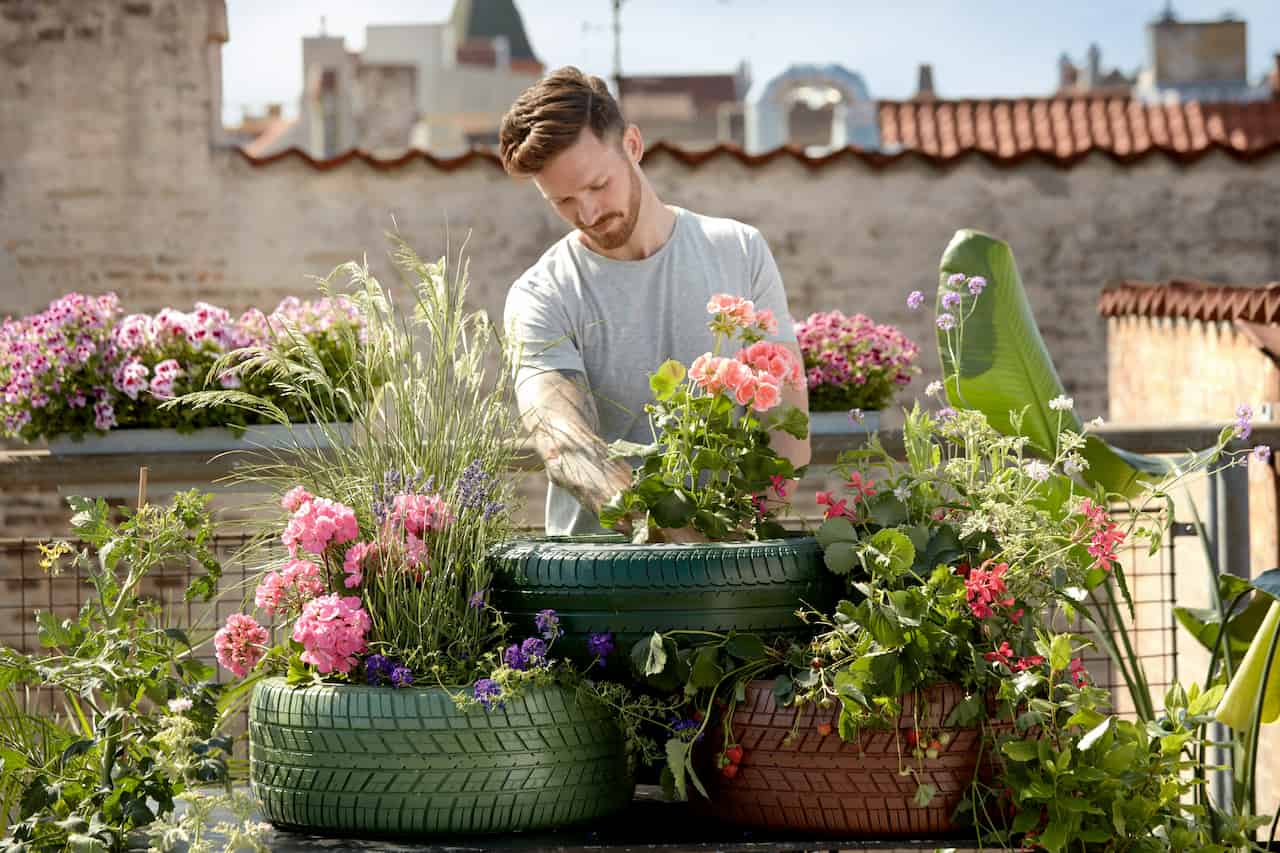
The best plant containers are not always the ones sold as plant containers. An old tin bath, a worn welly boot, a redundant colander, a wooden wine crate or a cracked Belfast sink can all make excellent planters – often more visually interesting than anything available from a garden centre – and the pleasure of growing something successfully in an object that would otherwise have been discarded adds a dimension to container gardening that new-from-the-shelf pots simply cannot provide. Upcycled container gardening has become one of the most popular expressions of creative growing in UK gardens, particularly in small urban spaces where traditional gardening is limited and visual interest matters as much as yield or productivity.
The practical requirements for any container are simple: it must hold compost without disintegrating, allow excess water to drain freely and not leach anything harmful into the growing medium if used for food crops. Almost every household object meets at least two of these criteria. The drainage and safety considerations are what separate a successful upcycled planter from a frustrating one. A container that retains water without drainage will rot roots and kill plants within weeks regardless of how carefully it was planted up. Understanding these two fundamental rules before starting means almost any container can be used successfully with a small amount of preparation. A hand drill, a handful of gravel and a bag of good peat-free compost are genuinely all that is needed to get started.
Best Upcycled Container Ideas
Upcycled container types – suitability and preparation
Tin baths and galvanised troughs
Some of the most attractive upcycled planters available. Drill 6-8 drainage holes in the base with a metal drill bit. Line the base with a 3-4cm layer of gravel or broken crocks before adding compost to prevent the holes blocking. Safe for food crops – galvanised metal does not leach harmful quantities of zinc into compost under normal growing conditions. Will rust on the outside over time, which adds to the aesthetic character of the container.
Wooden wine crates
Wine crates make excellent shallow planters for herbs,
strawberries and trailing flowers. Line the interior with hessian or a cut piece of weed-control membrane before filling with compost – this retains the growing medium while allowing drainage through the gaps in the wood. Untreated wine crate wood will last 2-3 seasons before rotting. Extending life is possible by painting the exterior with linseed oil, which penetrates and protects the wood without affecting the plants growing inside.
Colanders and sieves
Perfect for small herbs and trailing plants – the built-in holes provide ideal drainage and the metal construction looks striking on a wall or table. Line the interior with a loose layer of sphagnum moss before adding compost to prevent the growing medium escaping through the holes while still allowing free drainage. Hang on a fence or wall with a simple wire loop through the handle. Best for basil, thyme, trailing nasturtiums or compact annual flowers.
Wellington boots
A classic cottage garden upcycle that remains genuinely effective. Pierce several drainage holes in the sole with a sharp implement or drill. Fill the toe with a layer of gravel, then compost to within 3cm of the top. Best for a single bold trailing or flowering plant – nasturtiums, geraniums, small fuchsias or compact herbs. The limited compost volume dries out very quickly in warm weather, so check moisture daily and water thoroughly when needed. Works best as a group arrangement of different sizes and colours.
💡The single most important thing any container needs is drainage. Roots sitting in waterlogged compost will rot within days regardless of how healthy the plant was at planting. If a container cannot have holes added – a decorative ceramic piece, for example – use it as a cachepot by placing a correctly drained inner pot inside the decorative outer one. Never fill the base of a drainage-free container with gravel expecting it to act as drainage – it does not work and simply reduces the available root space.
Preparing Any Container for Planting
Container materials – food safety and preparation guide
Material
Food crops safe?
Preparation needed
Galvanised metal
Yes
Drill drainage holes, add gravel layer
HT-stamped pallet wood
Yes
Line with hessian or membrane
Untreated softwood
Yes
Seal exterior with linseed oil only
Food-grade plastic
Yes
Drill drainage holes if absent
CCA pressure-treated timber
Avoid
Contains arsenic – ornamentals only
MB-stamped pallets
Avoid
Methyl bromide treated – not safe
The choice of compost matters as much as the container. Peat-free multi-purpose compost is the right choice for virtually all container growing – it has the open, free-draining structure that container roots need, retains enough moisture between waterings without becoming waterlogged and is enriched with enough slow-release nutrients to support plant growth for the first 6-8 weeks without supplementary feeding. Avoid using garden soil in containers – it compacts badly, drains poorly and brings in weed seeds and soil-borne pests. Old compost from previous seasons can be mixed 50/50 with fresh to extend it, but should not be used neat in containers for food crops as it will be depleted and may carry disease.
What to Grow in Each Container Type
Container volume vs best crops
Herbs (thyme, chives, basil, mint), cut-and-come-again salad leaves, radishes, spring onions. Small containers dry out very quickly in warm weather – choose drought-tolerant herbs or be prepared to water daily. Keep mint contained – it spreads aggressively in open ground and is far better managed in a small pot.
Strawberries, trailing nasturtiums, compact patio tomatoes, dwarf French beans, beetroot, chard, pansies, pelargoniums. Wine crates and tin baths in this volume range can support a full season of productive growing with regular feeding from June onwards.
Courgettes, standard tomatoes, potatoes,
dwarf fruit trees, climbing beans on a support, large shrubs. Old tin baths and troughs in this volume range can support genuinely productive food growing for a full season. Potatoes grow well in old hessian sacks, builders buckets or repurposed compost bags of this volume – simply fill, plant and roll down the sides as the plants grow.
Amazon
Upcycled container gardening essentials – UK picks
As an Amazon Associate I earn from qualifying purchases. Prices correct at time of publishing.
Container Care Through the Season
Container growing – rules and reasons
Rule
Why
Feed every two weeks from June
Container compost is quickly exhausted of nutrients by actively growing plants, particularly in summer. A liquid feed every two weeks from June maintains productivity and prevents the yellowing leaves that indicate nutrient deficiency rather than drought or disease.
Water before compost fully dries
Completely dry compost is hydrophobic – water runs off the surface and down the sides without being absorbed by the roots. Push a finger 2cm into the compost to test; if dry at this depth, water slowly until it drains from the base holes.
Refresh compost annually for edibles
Used compost is depleted of nutrients and can carry soil-borne pests and disease from one season to the next. Empty, clean and refill containers with fresh peat-free compost each spring. The old compost makes an excellent mulch for borders or a useful addition to the compost heap.
Protect metal containers from hard frost
Metal conducts cold efficiently and compost in a metal planter can freeze solid in a hard frost, killing plant roots. Move vulnerable containers to a sheltered position from October, or wrap with several layers of horticultural fleece as a practical alternative to moving large or heavy containers.
The creative potential of upcycled container gardening is one of its most compelling qualities for small and urban gardens. The best displays combine containers of very different heights, materials and styles to create a layered, textural composition that no matching set of purpose-bought pots could achieve. An old tin bath planted with trailing nasturtiums alongside a wooden wine crate filled with strawberries and a colander of mixed herbs hung at eye level on a fence creates a vertical growing display that is visually striking, genuinely productive and costs almost nothing beyond the compost and plants. The principle is straightforward: if it holds compost, drains freely and does not leach anything harmful, it is a planter. The rest is creativity. Strawberries in wine crates, nasturtiums in colanders and herbs in old boots all combine to create a display that is uniquely personal to the gardener who made it, and that is a quality worth more than any expensive purpose-made container.
Amazon
Upcycled container gardening essentials – UK picks
As an Amazon Associate I earn from qualifying purchases. Prices correct at time of publishing.
Watering is the most time-intensive aspect of upcycled container gardening and it scales directly with the number of containers. A single large tin bath may need watering every two to three days in dry summer weather; a dozen small welly boots and colanders may need daily attention. Self-watering inserts – plastic reservoirs that sit in the base of containers and allow plants to draw moisture upward as needed – significantly reduce the watering burden and are worth using in smaller metal containers where drying out is a persistent problem. Positioning containers in partial shade during the hottest weeks of summer also reduces moisture loss considerably, and for herbs that genuinely prefer full sun, a brief afternoon shadow is far preferable to the stress of drying out completely between waterings. Grouping containers together also reduces moisture loss as the plants create a microclimate of slightly higher humidity around each other, which is beneficial to all of them.